The Chair Seat That Grows in a River
Small Certainty
A rush-seated chair is easy to underestimate. Its frame is open, its weight modest and its seat made from a plant that spends the first part of its life standing in water. There is no upholstery to suggest comfort and little surface on which a manufacturer can perform expense. Yet a good one can remain at a kitchen table for decades, acquiring the polish of use while asking only that, eventually, somebody weave the seat again.
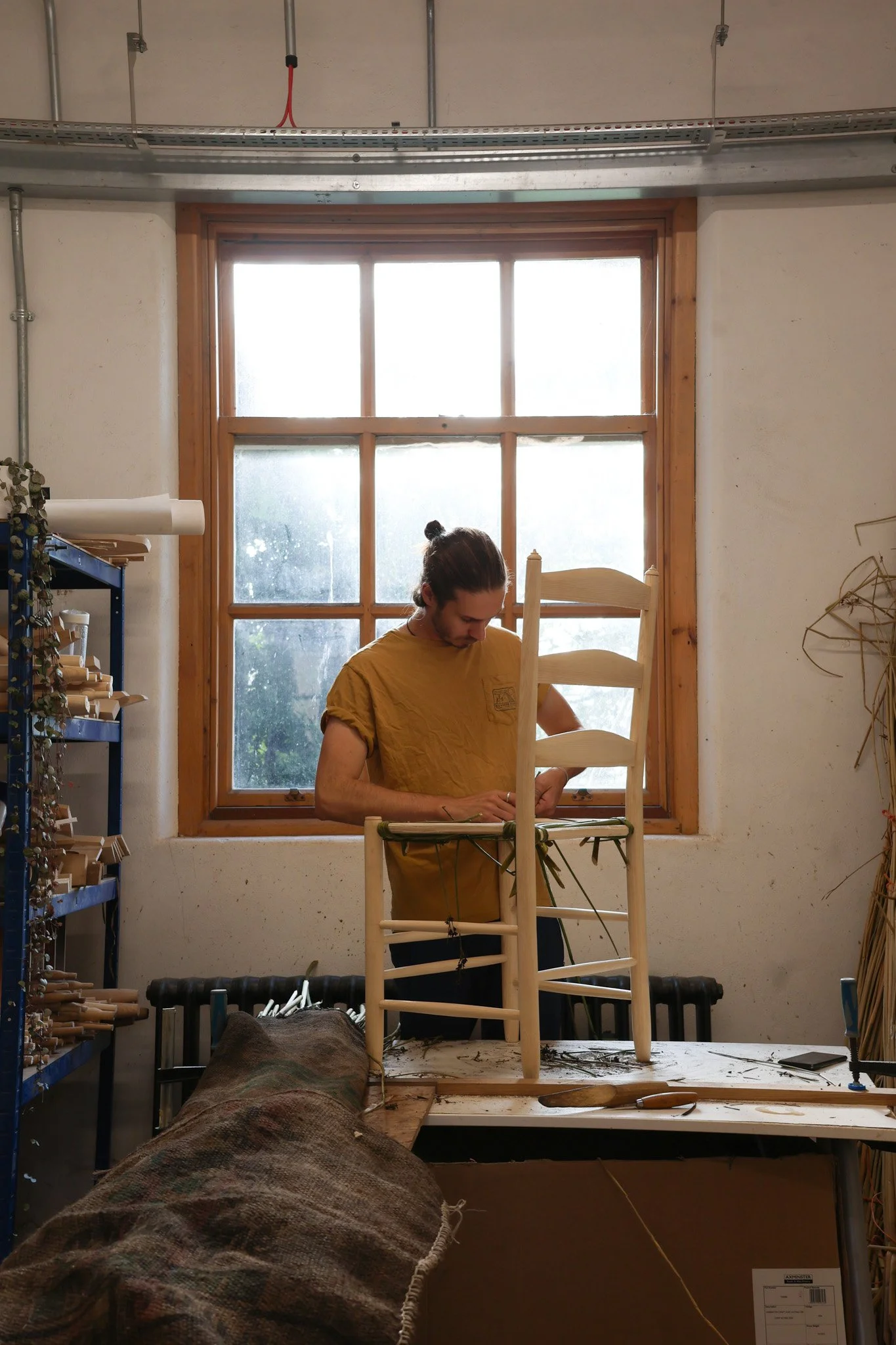
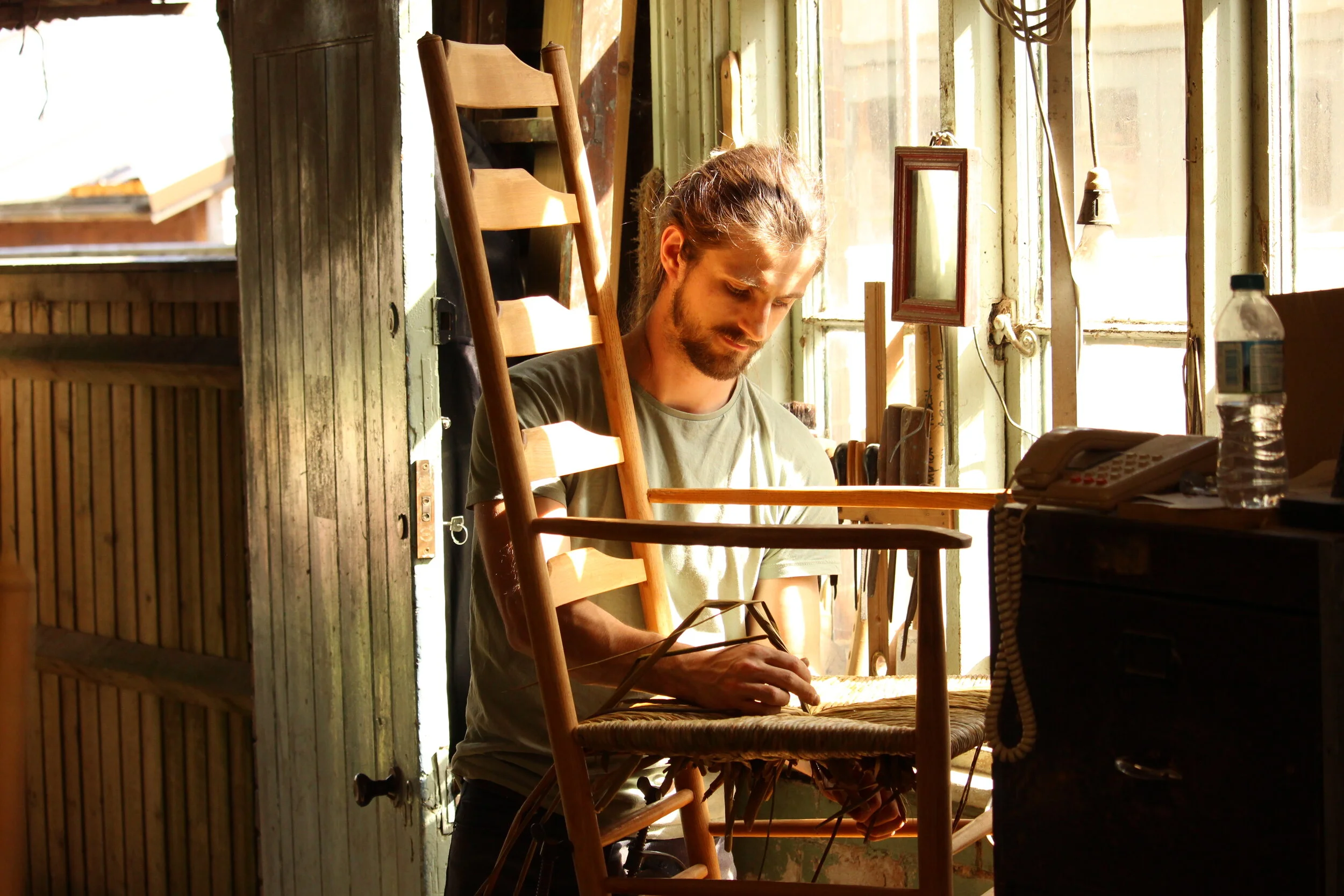
At Marchmont Workshop, on an estate near Greenlaw in the Scottish Borders, Richard Platt and Sam Cooper make this apparent simplicity exact. They select local hardwood, turn and steam-bend the components by hand, harvest common river rush in summer and weave each seat in the workshop. The chair is designed from tree to home, but its real distinction is continuity: woodland, river, maker, owner and repairer remain close enough to understand one another.
SIX GENERATIONS BETWEEN TWO HANDS
The workshop’s lineage runs through the English Arts and Crafts tradition. In 2018, Platt and Cooper apprenticed with Lawrence Neal, inheriting techniques passed through six generations and associated with makers including Ernest Gimson and Phillip Clissett. When they founded Marchmont Workshop in 2020, rush-chair making in Britain had contracted to a few practitioners. What survived was not simply a historic silhouette but a working system of judgements: how wet ash will bend, how a rung should meet a leg and how much tension a green strand can take before it bruises or breaks.
An endangered craft is often presented as a collection of gestures preserved from change. This one is more practical. The knowledge matters because it continues to solve the chair. A side chair must be light enough to move, strong enough to tolerate a person leaning back and comfortable without foam, springs or a concealed sheet of plywood. The inherited methods are not ceremony around the object; they are the shortest route to its performance.
THE HARVEST
Common rush grows in fresh water, sending dark-green stems upwards from spring until they are ready to cut between late June and early August. The Marchmont makers harvest theirs from the rivers Wansbeck and Avon, working in waders with long slashing hooks. Around a thousand bundles are tied and left to dry in the summer sun. Once dry, the rush will keep indefinitely; before weaving, it is wetted again so that the stems recover their suppleness.
This seasonal work gives the finished chair a material honesty that sourcing language rarely achieves. The makers can identify the woodlands around the workshop and the rivers that supplied the seat. More importantly, they understand variation before it becomes a production problem. Rush is not an extruded cord. Stems narrow, thicken and carry the record of weather. Selection is part of weaving: two or three compatible lengths are twisted into an even strand, and weak or inconsistent pieces are discarded before they become a weak place in the seat.
A FEW HUNDRED REPETITIONS
The weave is straightforward enough to describe. The twisted strand passes over a seat rail, up through the frame and over itself to hold its position. The action is repeated a few hundred times, moving towards the centre as four triangular planes take shape. Description, however, removes the difficult part. Every pass changes the available space and the tension of the passes already made. The maker has to keep the surface level, the corners clean and the strand sufficiently taut without exhausting the material.
This is why a rush seat looks calm. Its pattern is the visible record of problems resolved at the moment they appeared. There are no fasteners and no adhesive holding the woven surface together; geometry and friction do the work. Stuffing inserted as the seat closes gives support without concealing the construction. The result is firm at first, then increasingly accommodating as use presses the rush into a surface particular to the people who sit on it.
REPAIR IS PART OF THE DESIGN
Daily use should give a well-made rush seat several decades. When it finally wears through, the frame need not be discarded. The old weave can be removed and a new one put in its place, restoring the chair without pretending that nothing has happened. Marchmont Workshop reseats older chairs as well as its own and teaches the process in small two-day courses, carrying the knowledge beyond the objects it can make itself.
The course is as consequential as the chair. Four students learn to select and prepare rush, control the weave, trim the ends and stuff the finished seat. Some arrive with a chair from home; others leave with a new frame. Either way, repair becomes less mysterious and the craft gains another possible practitioner. Preservation works best in this form: not as reverence for an untouchable example, but as enough distributed competence to keep ordinary good things in use.
A CHAIR WITHOUT AN ALIBI
Marchmont Workshop also makes contemporary pieces, including a chair developed with the veteran maker Mike Abbott and a Canopy chair whose back rail follows the form of an ash branch. These designs do not need to disguise their ancestry. The useful inheritance is structural rather than stylistic: local timber, greenwood construction, a renewable woven seat and proportions refined by people who expect the chair to be used rather than merely discussed.
The rush chair offers no technological surprise and requires none. It makes a narrower, more demanding promise: that the materials can be known, the joints understood, the seat renewed and the whole object kept in service long enough for fashion to lose interest several times. In a room full of furniture making larger claims, the light chair with the river-grown seat may be the one with the least to explain.